It was 11:47 PM on a Tuesday when a customer emailed Zara — founder of a mid-sized e-commerce brand in Karachi — about a missing order. By the time her two-person support team saw the message the next morning, the customer had already left a one-star review and moved on. This wasn't a one-off. It was happening dozens of times a week, and it was quietly bleeding the business dry.
Zara came to us at Athena Sols with a straightforward problem: her support costs were spiraling out of control, her team was exhausted, and customer satisfaction scores were falling. A year after deploying a custom AI chatbot, she had reclaimed over $50,000 in operational savings — and her team was finally getting a full night's sleep.
The Real Cost of Reactive Support
Most business owners treat customer support as a fixed cost — a line on the P&L that doesn't change much. The reality is far messier. When you account for agent salaries, training, turnover, after-hours coverage, and the downstream cost of unresolved tickets — refunds, churn, negative reviews — the true cost of support can be 3–4× what the payroll budget suggests.
In Zara's case, her team was fielding around 400 repetitive queries per month: order status checks, refund policy questions, delivery timelines, product compatibility. These were questions with known, consistent answers. Yet each one required a human to open an email, look up an order, type a reply, and move on. At roughly 8 minutes per ticket, that's over 50 hours of human labor every month — just on copy-paste replies.
- Average first-response time: 14 hours
- Monthly repetitive tickets: 400+
- Estimated monthly labor cost on repetitive queries: $4,200
Why Generic Chatbots Failed — and What We Built Instead
Zara had tried two off-the-shelf chatbot tools before working with us. Both disappointed. They handled simple FAQs but fell apart the moment a customer asked anything outside a predefined script. Worse, they felt robotic — customers could tell they were talking to a machine, and frustration actually went up.
The difference with a custom AI chatbot is intent understanding. Rather than matching keywords to canned responses, our solution uses a language model fine-tuned on Zara's actual order data, returns policy, product catalog, and historical support conversations. It understands context, handles follow-up questions, and escalates to a human agent only when confidence is low.
Here's a simplified look at the intent-routing logic we built:
// Classify incoming message and route to the right handler
async function routeIntent(userMessage, sessionContext) {
  const intent = await classifyIntent(userMessage);

  switch (intent.type) {
    case 'order_status':
      return fetchOrderStatus(sessionContext.userId);
    case 'refund_request':
      return handleRefundFlow(sessionContext);
    case 'product_query':
      return searchProductCatalog(userMessage);
    default:
      return escalateToHuman(sessionContext); // graceful handoff
  }
}
Crucially, the chatbot was embedded directly inside Zara's existing Next.js storefront — no third-party widget, no clunky iframe. It felt like a native part of the brand experience.
The Integration That Made It Actually Work
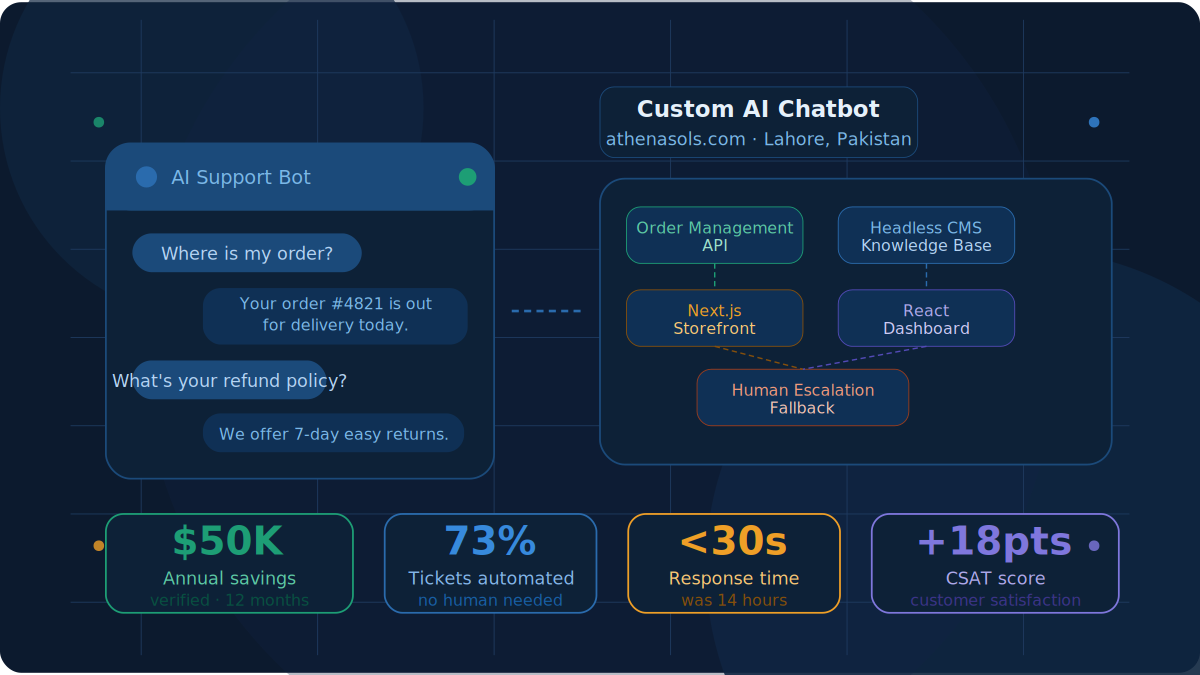
A chatbot is only as useful as the data it can access. One of the biggest wins in Zara's deployment was the deep integration between the chatbot and her order management system. When a customer asks "Where is my order?", the bot doesn't just recite a policy — it pulls live tracking data and gives a real answer, instantly.
We built this integration layer using a headless CMS to manage the chatbot's knowledge base — FAQs, product descriptions, policies — and a set of secure API connections to her fulfilment platform. Updating the chatbot's knowledge requires no code: Zara's team edits content in a clean dashboard, and the chatbot reflects those changes within minutes.
- Frontend: Next.js chatbot widget, embedded server-side for performance
- Knowledge base: Headless CMS (Sanity) for policy, FAQs, and product info
- Live data: Webhook connections to order management and logistics APIs
- Escalation: Automatic handoff to human agents with full conversation context
- Analytics: Custom React dashboard tracking resolution rate, CSAT, and escalation triggers
The Numbers After 12 Months
The results after a full year of deployment were striking:
- 73% automated resolution rate — nearly three-quarters of all support queries handled with zero human involvement
- Average first-response time dropped from 14 hours to under 30 seconds
- Customer satisfaction score climbed 18 points
- $50,000+ in annual savings across reduced labor, refund leakage, and avoided churn
Two part-time support agents whose hours were consumed by repetitive queries were reassigned to higher-value work — managing partnerships and handling genuinely complex customer issues. The business didn't shrink its team; it made the team dramatically more effective.
The chatbot also surfaced something unexpected: a detailed log of questions customers were asking that no one had thought to answer publicly. Zara used this data to rewrite her product pages and FAQ section, reducing inbound query volume further still.
Is a Custom AI Chatbot Right for Your Business?
Not every business needs a bespoke solution — but if you're dealing with high support volume, repetitive query patterns, or a customer experience that feels inconsistent, a custom chatbot is worth serious consideration. The key word is custom. Off-the-shelf tools are built for the average use case. Your business isn't average.
At Athena Sols, we specialise in building AI chatbots that integrate with your existing stack — whether that's a React frontend, a custom CMS, a Shopify backend, or a proprietary CRM. We understand your workflows, design around your data, and build something that gets smarter over time.
The approach works across industries: e-commerce, SaaS, real estate, healthcare, logistics. If your team is spending more than 20 hours a month on repetitive support queries, the ROI case for automation is almost always compelling.
Conclusion
The $50,000 saving Zara achieved wasn't a fluke — it was the result of building the right solution for the right problem, with the right integrations in place. Small, consistent improvements in support automation compound fast. Keep your chatbot well-integrated, your knowledge base current, and your escalation paths clean — and the results take care of themselves.
If you're ready to explore what a custom AI chatbot could do for your business, our team at Athena Sols is happy to walk you through it — no jargon, no pressure, just a clear picture of what's possible.
Let's build something that works for your business
Book a free 30-minute discovery call with our team. We'll assess your current support setup, identify automation opportunities, and give you a realistic picture of potential savings.
Talk to Athena Sols →